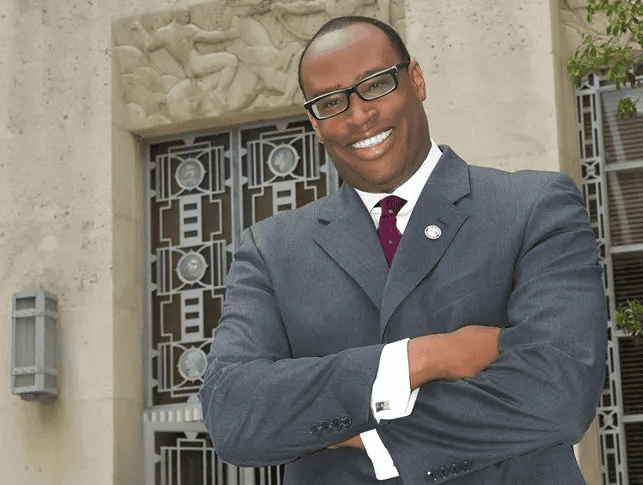
Council Member Larry V. Green (1965–2018)
Before there was a reinvestment zone, before there was an authority, before there was a $150 million project plan — there was a problem that everyone could see and no one was solving.
Southwest Houston’s sidewalks were crumbling. Its commercial corridors were lined with vacant lots. The roads that carried 100,000 residents to work every morning were patched, not rebuilt. Developers who could have been building here were building in Pearland and Sugar Land instead — communities just a few miles south that offered newer infrastructure and fewer headaches.
Larry Green saw all of it. He had seen it his entire life.
“This area has been neglected in regard to infrastructure improvements,” Green told the Houston Chronicle in 2013. “We’ve gotten a lot of residential development, but our commercial is slow coming. If we incentivize it, they would come.”
He wasn’t the only one who saw the gap. Community leader Vivian Harris stood along the corridor and pointed to empty parcels stretching in every direction. Joshua Sanders of Houstonians for Responsible Growth put the competitive threat in plain terms — businesses were choosing to cross the highway into Fort Bend County suburbs rather than invest in the neighborhoods that needed them most.
Although Larry Green was the one of several who did something about it — he took it to entirely different heights.
He didn’t write an op-ed. He didn’t form a committee to study the problem. He built the institutional machinery that would channel this community’s own tax dollars back into its own streets, sidewalks, lighting, drainage and public spaces — openly, accountably and permanently…
TIRZ 25. The authority he championed into existence is the Hiram Clarke Fort Bend Redevelopment Authority. And every improvement you see in this zone today — every safer intersection, every new trail, every blighted property cleared, every nationally recognized project — traces back to the foundation he laid.
But…
Long before Larry Green became the architect of all of that, he was a kid riding bikes in Hiram Clarke.
A Son of This Community
Larry Vincent Green was born on May 16, 1965 and raised in the Hiram Clarke neighborhood of southwest Houston — the same community he would later spend his career fighting to transform.
He attended William P. Hobby Elementary School, where he met a lifelong friend in Francis Page Jr., the future publisher of Houston Style Magazine. The two bonded over a shared love of bikes and a friendship that would span decades. He went on to Audrey H. Lawson Middle School and then Madison Senior High School — the same Madison High that would eventually receive a $94 million rebuild through the 2012 HISD bond, sitting squarely within the TIRZ 25 zone he would one day create.
Green earned a Bachelor of Arts in Political Science from the University of Houston and a Juris Doctor from the Thurgood Marshall School of Law at Texas Southern University.
In 1984, he was initiated into the Eta Mu Chapter of Alpha Phi Alpha Fraternity, Inc. at the University of Houston. He would later serve as president of the Alpha Eta Lambda Graduate Chapter and remain an active brother throughout his life. He was a dedicated member and trustee of Brentwood Baptist Church under the leadership of Rev. Dr. Joe Samuel Ratliff.
Every school he attended was in Houston.
Every institution he joined was rooted here.
Every formative relationship he built was forged in the neighborhoods he would eventually serve.
As former City Controller Ronald Green put it: “He’s from this area — a native Houstonian, a Madison High School graduate, a University of Houston graduate, a Thurgood Marshall School of Law graduate — so he’s a hometown boy. He has so many roots in this city.”
This wasn’t a politician parachuting into someone else’s district.
This was a native son who never left.
Building a Career in Service
The Attorney
For more than two decades, Larry Green practiced law in Houston as a trial attorney. He’s been described as “a tenacious and successful trial lawyer” who was “considered an advocate for those who had been discriminated against, having successfully won several high-profile cases on behalf of his clients.”
He operated his own firm, Larry V. Green & Associates and also served as municipal finance counsel of counsel with the nationally recognized Hardwick Law Firm — experience that would later prove invaluable when he began structuring the financial and legal architecture of TIRZ 25.
His legal career built the foundation for everything that followed: deep relationships across Houston’s civic, legal and political communities, a command of public policy and municipal governance and a reputation for tenacity on behalf of people who had been overlooked.
Congressional Service and Workforce Leadership
Green served as District Director for U.S. Representative Sheila Jackson Lee in the 18th Congressional District — a role that gave him direct exposure to federal policy, constituent services and the mechanics of government advocacy at the highest level. Congresswoman Jackson Lee would later say of him: “He stood tall and never turned his back on Hiram Clarke.”
In 2008, Green was selected as the sole finalist in a nationwide search for the position of President and CEO of HoustonWorks USA, a workforce development nonprofit. Under his leadership, the organization experienced unprecedented revenue growth and diversified its funding base to include first-time legislative appropriations and support from corporate foundations, private entities and individual donors. The role cemented his expertise in economic development, job creation and community empowerment — the exact toolkit he would need to build what came next.
The Decision to Run
When the City of Houston created the new District K for the 2011 municipal elections — a sprawling district stretching from the edge of the Texas Medical Center to the portion of Houston within Fort Bend County — Green announced his candidacy to the HoustonWorks USA Board of Directors. He won the race, took office in January 2012 and became Houston’s first-ever Council Member for District K.
He would win two subsequent elections, running unopposed in 2015. District K encompassed the Reliant/Astrodome Complex, three management districts, two school districts and what would become two Tax Increment Reinvestment Zones. It was one of the largest and most diverse council districts in the city — and it had been waiting decades for someone to fight for it at City Hall.
Larry Green was that person.
The District K Years — What He Built
The Numbers
During his six years on Houston City Council, Larry Green brought close to $2 billion in economic development projects to District K. In his first term alone, he delivered over $20 million in direct investment — including a new Houston Police Department substation, neighborhood street reconstruction projects, a senior citizen center in Fort Bend Houston and the creation of a Tax Increment Reinvestment Zone for the Hiram Clarke and Fort Bend Houston area.
Those numbers tell one story. The institutions he built tell a bigger one.
The TIRZ 25 Legacy
The centerpiece of Larry Green’s public service career — and the reason this authority exists today — is TIRZ 25.
On August 7, 2013, Green championed the passage of Houston City Council Ordinance No. 2013-708, officially designating the Hiram Clarke and Fort Bend Houston area as Tax Increment Reinvestment Zone Number Twenty-Five. The zone’s 30-year duration would run through December 31, 2042, with a projected $141 million in tax revenues directed into public improvements.
But creating the zone was only the beginning. Green understood that a TIRZ designation alone could not deliver results — the community needed an independent corporate entity with the legal authority to issue bonds, enter contracts, employ staff and manage projects directly. So he built one.
Over the next two years, he guided a sequence of legislative actions that constructed the entire institutional framework:
October 28, 2013 — City Council confirmed a seven-member board of directors to govern the zone.
November 7, 2013 — The inaugural board meeting convened at Hiram Clarke Multi-Service Center. Green administered the oath of office to the newly confirmed directors. The meeting was open to the public from day one.
March 25, 2015 — City Council approved both the FY2015 operating budget and the interlocal agreement with Fort Bend County — a cross-county collaboration that Green and Fort Bend County Commissioner Grady Prestage worked together to secure, enabling tax increment collection across two jurisdictions.
May 12, 2015 — City Council passed Resolution No. 2015-19, formally establishing the Hiram Clarke Fort Bend Redevelopment Authority as a public nonprofit corporation. The authority Green fought to create could now move on infrastructure independently — without routing every action through City Hall’s broader bureaucracy.
December 2015 — City Council adopted the tri-party agreement between TIRZ 25, TIRZ 9 and the 5 Corners Improvement District — a coalition that the Houston Chronicle reported would invest “well over $150 million” into southwest Houston over the coming decade.
The mechanism Green built solved the fundamental problem he had identified from the start.
Before the TIRZ existed, the tax dollars generated within southwest Houston were spread across the entire city.
The infrastructure improvements this community needed — the sidewalks, the drainage, the lighting, the roadways — were deprioritized against citywide demands and deferred for years, sometimes decades.
TIRZ 25 changed that equation permanently. The tax increment generated within the community would now be reinvested within the community — through a publicly governed, transparently operated authority accountable to the residents it served.
Business and Equity Advocacy
Green’s impact at City Hall extended well beyond District K boundaries. He led the effort to increase Houston’s Minority and Women Business Enterprise and Small Business Enterprise participation goals from 22 percent to 34 percent — a landmark policy shift that reshaped how the city awarded contracts.
He ensured that women-owned businesses were included back into the city’s affirmative action contracting program. Council Member Jerry Davis noted the specificity of Green’s advocacy: “Larry took it to another level, where it wasn’t just a vague minority focus. He wanted to know about how Blacks specifically would be a part of the contract.”
In 2016, the City of Houston’s Office of Business Opportunity awarded Green the Chairman’s Award at its Champions of Diversity Awards Ceremony — recognition of years of sustained advocacy for the entrepreneurs and small business owners who were building wealth in communities across the city.
Public Art and Community Identity
Green understood that infrastructure alone does not transform a community’s identity.
In 2015, he sponsored 31 Mini Mural traffic signal cabinets in District K — the pilot phase of a program created by UP Art Studio founders Noah and Elia Quiles that transformed utilitarian eyesores into neighborhood landmarks.
The sponsorship made District K “ground zero” for what has since grown into a citywide movement with more than 400 painted cabinets across Houston.
He also created the “Klean It Up / Green It Up” beautification initiative, which mobilized residents around neighborhood pride and environmental stewardship.
Green sat for one of his final television interviews with ABC13, discussing the Mini Mural projects and the legacy he hoped to leave behind. The murals, he believed, were proof that public reinvestment in a community could reach beyond concrete and asphalt — into culture, identity and belonging.
City Hall Leadership and National Impact
Mayor Annise Parker appointed Green as Chair of the Transportation, Technology and Infrastructure Committee — a post he retained under Mayor Sylvester Turner. The committee oversaw the city’s Information Technology and General Services departments, Houston Public Works, the Houston Airport System, METRO, the Port of Houston and the ReBuild Houston streets and drainage program. It was one of the most consequential committee assignments on City Council and Green held it for the duration of his tenure.
He was elected to the National League of Cities Board of Directors, where he served on the Finance, Administration and Intergovernmental Relations Steering Committee — helping to guide the advocacy priorities of an organization representing 19,000 cities, towns and villages across the country.
He led a delegation to Cuba on an educational excursion to identify economic and civic opportunities that could benefit Houston. And he advocated in Washington, D.C. for a $9.4 million federal grant from the U.S. Department of Transportation to install flood warning technology at 40 flood-prone intersections across Houston — including Alt. U.S. 90 and Beltway 8 in his own district.
That grant was announced on March 6, 2018 — the same day Larry Green died.
Mayor Turner called it proof that “even though Council Member Green’s chair may be empty, he’s still fighting for the everyday people in his district.”
The Man Behind the Title
The policy record is extraordinary. But the people who knew Larry Green don’t talk first about ordinance numbers and committee appointments. They talk about the person.
Mayor Sylvester Turner described him as “very hands-on, very committed, very dedicated, very hardworking and didn’t mind challenging anyone if he felt they were not getting what they needed in District K.” In the same breath, Turner noted that Green “shared in the economic advances and public safety strides of the district without taking the credit for himself.”
At the Pinnacle Senior Center in Fort Bend Houston — a facility Green helped bring to life — employees remembered him sitting on benches outside, listening to constituents’ concerns. One employee, Leroy Price, would later say through tears: “I’m most proud of how you actually had a voice.” Green would go out of his way to greet people he recognized in the community, not as a political gesture but as a matter of personal character.
State Senator Borris Miles, captured the arc of their shared journey: “Council Member Green and I have been friends since we were 13. As we grew up, we talked about how we would make our community better. As elected officials, we did just that.”
A fraternity brother recounted being surprised to discover Green’s playful side at a Houston Rockets game, where he found the council member rapping along to Lil Wayne with complete abandon. “It was the first time I met homeboy Larry,” the brother laughed — a reminder that behind the policy achievements was a person who was deeply, genuinely human.
Congressman Al Green offered perhaps the most telling tribute of all: “Larry cared about people who could never make a single contribution to his campaign.”
March 6, 2018
On the morning of March 6, 2018, Houston Police Department officers conducting a welfare check found Council Member Larry Vincent Green unresponsive in his home. He was 52 years old.
The news broke just before the weekly City Council meeting. Mayor Turner opened the session with condolences. A moment of silence was observed. That evening, Houston City Hall was lit in green.
Six days later, on March 12, hundreds filled Brentwood Baptist Church for Green’s homegoing celebration — so many that an overflow area was required to accommodate the crowd. The service was officiated by Dr. Joe Samuel Ratliff and featured remarks from Mayor Turner, Congresswoman Sheila Jackson Lee, Congressman Al Green, State Senator Borris Miles, Commissioner Rodney Ellis, Council Member Jerry Davis, Chief of Staff Donald Perkins and Alpha Phi Alpha’s 31st General President Harry E. Johnson Sr. Hundreds of fraternity brothers attended a separate Omega service preceding the funeral.
Mayor Turner proclaimed March 12, 2018, as Councilman Larry V. Green Day in the City of Houston. A Larry Green Scholarship Fund was announced at the service, with $15,000 pledged on the spot.
Martha Castex-Tatum, who had served as Green’s Constituent Liaison for District K, spoke to what he had built and what would endure: “Council Member Green was a caring visionary. He was a champion for the constituents of District K. His passion and dedication to improving our community was contagious. He laid an amazing foundation for this district and we will continue the great work he started.”
Castex-Tatum would succeed Green as District K Council Member in a special election held on May 5, 2018 and would later serve as Mayor Pro Tem — continuing the championing of TIRZ 25 and the broader vision Green had set in motion.
Congresswoman Sheila Jackson Lee, who had hired Green as her district director years earlier and counted herself among his mentors, delivered a tribute that captured what the community had lost: “Larry was an extraordinary human being with an unsurpassed exuberance and passion for our city, its neighborhoods, its future and most of all, its people.”
Commissioner Rodney Ellis kept it simple: “We are grateful for a young man that left us too early, but my friends, he left his mark.”
The Legacy That Keeps Building
The framework Larry Green has built has not stopped producing results for a single day.
$50 million. That is the cumulative investment milestone the Hiram Clarke Fort Bend Redevelopment Authority announced on July 4, 2025 — every dollar tracked through the transparent governance system Green demanded from day one.
$150 million. That is the total project plan now spanning through 2042 — the long-term vision he set in motion with Ordinance No. 2013-708.
The District Gateway Improvement Project — a $1.1 million transformation of five major intersections along US 90A, funded through the tri-party collaboration Green architected — earned a 2024 ACEC National Engineering Excellence Award, a 2024 ACEC Texas Gold Medal and a 2023 APWA Texas Chapter Project of the Year. It was one of only three Houston projects honored nationally at the Washington, D.C. ceremony. The collaboration between TIRZ 25, TIRZ 9 and the 5 Corners Improvement District that produced this project exists because Green built the agreement that made it possible.
The Beltway Southwest Business Park — one million square feet of Class A industrial space delivered through public-private partnership with Hines — was made possible in part by the TIRZ framework. Hines credited TIRZ 25 as “an integral part of the development.”
The Edison Cultural Arts Center — a $56.7 million cultural anchor rising on 12.5 acres, featuring a 400-seat main stage theater, healthcare clinic, business incubator, culinary co-op and 12,000-square-foot outdoor performance space — carries his name. The main stage is called the Larry V. Green Theater. HCFBRA’s $500,000 demolition commitment helped unlock the entire $56.7 million project — a multiplier effect that turned half a million dollars into a generational cultural institution expected to welcome 80,000 visitors annually.
The Fuqua Land Project — the authority’s first land acquisition, clearing a long-standing community nuisance through EPA brownfield partnership — was completed under the institutional authority Green created.
The Mini Murals he sponsored with 31 cabinets in District K have grown into a citywide movement of more than 400 installations across Houston.
And the project pipeline continues to grow — all flowing through the institutional framework one council member put in place.
In May 2025, the Houston Arts Alliance issued a call for artists on behalf of TIRZ 9 for a permanent large-scale outdoor sculpture at Simon Michen Park honoring the life and service of Council Member Larry V. Green. His legacy is being carved into the physical landscape of the community he loved — literally.
Larry Green’s greatest achievement was not any single project.
It was creating the institutional framework that would keep producing results for this community for decades after he was gone.
Council Member Larry Vincent Green (May 16, 1965 – March 6, 2018). Son of Hiram Clarke. First Council Member of District K. Architect of TIRZ 25. The foundation southwest Houston stands on.